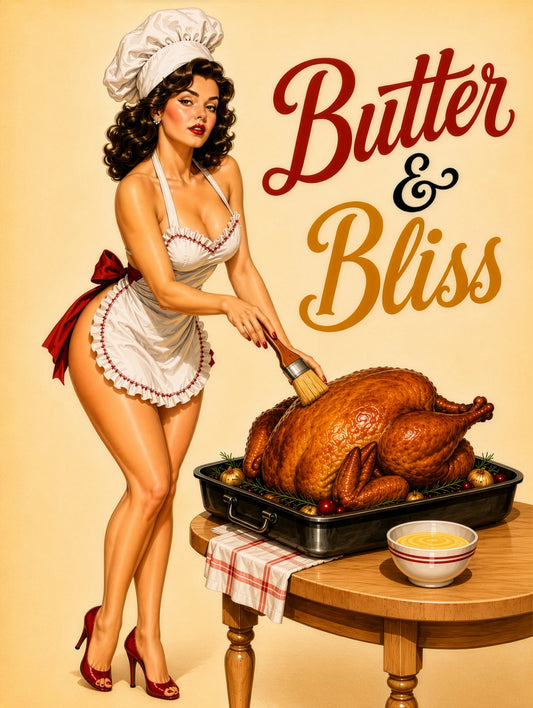
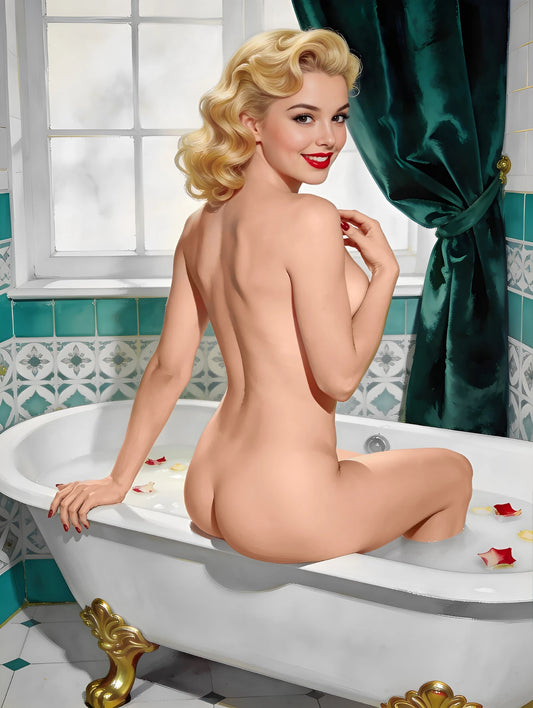
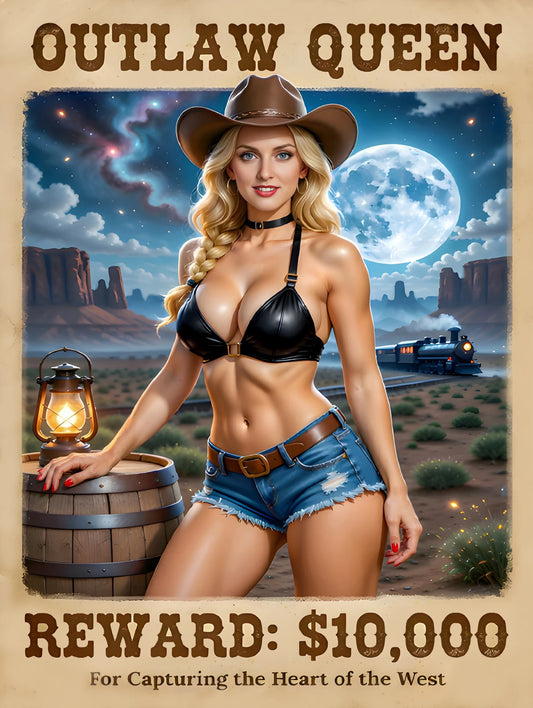
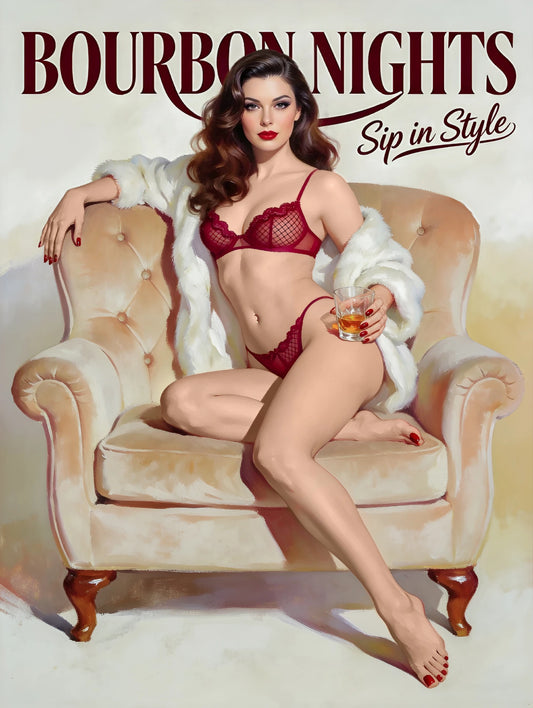
There's a particular kind of paradox at the center of golden-age pin-up art: the image is entirely about a woman, but the artist creating it is almost never a woman. The men who built the genre — Rolf Armstrong, Gil Elvgren, George Petty, Earl Moran — were all painting a version of femininity constructed from the outside, filtered through their imagination, their preferences, and the specific commercial demands of the calendar and magazine trade. The women in the pictures had no say in how they were rendered.
Zoe Mozert had quite a lot of say. She was the woman in the picture.
<cite index="22-1">Mozert was one of the early 20th century's most famous pin-up artists and models. She frequently was her own model, using cameras or mirrors to capture the pose.</cite> For over four decades, she sat in front of mirrors, rigged elaborate camera setups to capture her own form from multiple angles, and then walked back to the easel and painted what she saw — which was herself, in pastels, rendered into some of the most widely reproduced calendar art of the twentieth century. <cite index="23-1">In the 1950s, Mozert was at the peak of her career, reputedly the highest-paid calendar artist of all time. Between 1940 and 1960, more than 35 million reproductions of her paintings had been sold around the world.</cite>
Thirty-five million reproductions. Of paintings she made of herself.
At Pinup Art Studio, Mozert's approach — the idea that the most compelling pin-up art comes from a real woman's own engagement with her own image, not from someone else's filtered imagination — resonates with everything we do. Here is her full story. 🌹
🖌️ The Life of Zoe Mozert: From Colorado Springs to Calendar Immortality
Born Alice Adelaide Moser 🌄
<cite index="24-1">Born Alice Adelaide Moser on April 27, 1907, in Colorado Springs, Colorado, much of Mozert's early life was transitory. After stints in rural hamlets like Beaver Dam City, Wisconsin, and Newark, Ohio, her family eventually settled in Scranton, Pennsylvania, where her father became superintendent of the Scranton Stove Works.</cite>
Even the name she became famous under was a deliberate, considered reinvention. <cite index="24-1">It was during her early career that she adopted the pen name Zoe Mozert. While a professional norm at the time, Mozert had fun adopting the new persona. "I looked through a name dictionary for a new first name," she said in an interview. "When there were finally no pages left, I settled on Zoe."</cite> The surname Mozert was a phonetic rearrangement of her birth surname Moser — a small, practical transformation that gave her something that sounded like it belonged on a marquee.
Training in Philadelphia 🎓
<cite index="22-1">In 1925, Mozert entered the Pennsylvania Museum School of Industrial Art, where she studied under Thornton Oakley, a former student of Howard Pyle, and modeled to raise money for tuition.</cite> Modeling to pay for art school while simultaneously becoming an illustrator is a neat encapsulation of the dual role that would define her entire career. From the very beginning, her own body and her artistic practice were intertwined in the most practical, unsentimental way possible.
Oakley's training — rooted in the Howard Pyle tradition of dramatic, narrative illustration — gave Mozert something her pastel technique alone couldn't: a sense of movement, humor, and storytelling that set her work apart from more static pin-up images. <cite index="24-1">Her pastel style owed a heavy debt to Rolf Armstrong, but her tutelage under Oakley gave her paintings movement, humor, and a sense of adventure that set them apart and made them instantly recognizable today.</cite>
We've profiled Armstrong separately in our Rolf Armstrong guide — the Armstrong-Mozert pastel lineage is one of the most interesting teacher-to-student-to-peer relationships in the history of the genre, even though Mozert learned from his style rather than directly from him.
The Pulp Magazine Years 📰
<cite index="24-1">Her first freelance work came from one of the pulp magazines of that era, Bernarr Macfadden's True Story, in 1932. Between 1934 and 1937, Mozert became an in-demand pulp artist. While her work was extremely sensual, her subjects were more than their sexuality, often depicting realistic women in moments of genuine eroticism rather than the sordid, empty-eyed women depicted by other pulp artists.</cite>
That distinction — realistic women with individuality and emotional presence, rather than vacant fantasy figures — was already the defining quality of her work before she'd ever painted a single calendar pin-up. <cite index="31-1">Mozert is noted for rejecting sexy-girl clichés in favor of depicting more real-seeming young women with recognizably individual features and personalities.</cite> Given that she was often painting herself, this makes a certain kind of obvious sense: the woman she was rendering most frequently had a specific face, a specific body, and a specific personality she knew intimately, because it was her own.
<cite index="23-1">During this time she created the poster for the Paramount Pictures film True Confession (1937), as well as illustrated advertisements for Dr. Pepper, Kool Cigarettes, and Irresistible Beauty Aids.</cite>
The Brown & Bigelow Contract and Victory Girls 📅
<cite index="22-1">In 1941, publishers Brown & Bigelow bought Mozert's first nude and signed her to an exclusive calendar contract.</cite> The same calendar house that anchored the careers of Rolf Armstrong, Earl Moran — profiled in our Earl Moran guide — and Gil Elvgren — profiled in our Gil Elvgren guide — now had the only significant female artist in its stable.
<cite index="22-1">During World War II, her pin-up series for the company, called Victory Girls, was published both in calendar and mutoscope-card form.</cite> Mutoscope cards were small printed images distributed through coin-operated machines — essentially a 1940s vending-machine pin-up format — and the Victory Girls series circulated through both that format and the full calendar distribution network. Wartime demand for pin-up imagery was voracious, and Mozert was producing some of the most compelling material in the market.
The Big Four 🌟
<cite index="22-1">By 1950, Mozert had become one of the "big four" illustrators nationally, along with Rolf Armstrong, Earl Moran, and Gil Elvgren.</cite> This is the category that puts her achievement in proper context: the only woman in a group of four artists considered the absolute top tier of American calendar illustration at the genre's commercial peak. Not the best female pin-up artist — one of the four best, full stop.
<cite index="23-1">In the 1950s, Mozert was at the peak of her career, reputedly the highest-paid calendar artist of all time. Between 1940 and 1960, more than 35 million reproductions of her paintings had been sold around the world.</cite> That figure is staggering in any context, but it's especially striking when you consider that a substantial number of those 35 million images were, in some meaningful sense, self-portraits.
Paramount, Hollywood, and "The Pin-Up Girl Who Paints 'Em Too" 🎬
<cite index="23-1">The year the film was released, the 36-year-old Mozert and her husband moved to Hollywood.</cite> Paramount Pictures produced a short film about her during this period in its "Unusual Occupations" documentary series — <cite index="29-1">introducing her as "Zoë Mozert, internationally famous for her American beauties," and featuring a narrator who triumphantly announced, "Artist and model are one and the same!"</cite>
The short film showed exactly how she worked: <cite index="29-1">Periodically, Mozert cocked her head to the side and smiled; once the camera zoomed out further, we could see that she was observing her own reflection in a system of mirrors that displayed her form from all sides.</cite> The image — a woman simultaneously painting and being painted, artist and subject collapsed into one body — fascinated the public in a way that a male artist painting an anonymous model never could have.
<cite index="22-1">In 1946, Mozert created the publicity poster for Republic Pictures' Calendar Girl, a movie about the Gibson Girl. That same year, she painted the pin-ups for the Errol Flynn comedy Never Say Goodbye, in which Flynn played a pin-up artist. She also created the illustrations shown in the movie's opening credits.</cite> A male actor playing a pin-up artist, with the actual artwork created by the most famous female pin-up artist alive — the layers of irony were apparently lost on no one involved in the production.
She also created the poster for Howard Hughes's controversial film The Outlaw, starring Jane Russell — one of the most notorious advertising images of the 1940s and one that spent years in a legal battle over its own permissibility.
Song of the Desert: The Masterpiece 🌵
<cite index="25-1">Zoe Mozert's 1950 pastel "Song of the Desert" is by all accounts the artist's crowning achievement and most famous image — a luminous masterwork from the golden age of American pin-up. It is one of the most widely circulated and printed pin-up images of all time. It is a self-portrait of Mozert, who made a name for herself both as the most famous female American illustrator of her day and a frequent model for her erotically charged illustrations. Here she is seen as a modern embodiment of the mythical Lady Godiva.</cite>
A self-portrait as Lady Godiva — the medieval noblewoman famous for riding naked through the streets of Coventry as an act of protest and courage. It's a choice loaded with self-awareness: a woman who had spent decades painting herself into pin-up calendars, in a medium designed and consumed primarily by men, choosing for her masterpiece an image that connected her own body to a historical tradition of female agency and public self-exposure as deliberate act, not passive display.
Final Years in Arizona 🌅
<cite index="23-1">In 1978, Mozert retired to Sedona, Arizona, where she continued to produce pastel drawings and portraits, many of which were sold in fine art galleries. A shoulder injury in 1985 brought an end to her painting career. Zoë Mozert died on February 1, 1993, in Flagstaff, Arizona.</cite>
She had outlived most of the genre's other major figures and watched pin-up art complete a full cycle — from commercial ubiquity to cultural embarrassment to nostalgia to genuine art-historical reclamation — all within a single lifetime.
🎨 The Mozert Style: Pastels, Personality, and the Self-Documenting Artist
The Pastel Technique 🖍️
Mozert worked almost exclusively in pastel — a medium that rewards both speed and sensitivity, producing the soft, luminous skin tones and warm color gradations that made her work instantly recognizable. Her pastels have a particular quality of warmth and immediacy that oil painting rarely achieves: they look like they were made by someone who was genuinely interested in the specific person they were rendering, not just in producing a conventionally attractive figure.
That quality makes sense, given the subject. Painting yourself requires a different kind of attention than painting an external model. You're not approximating someone else's features from observation — you're navigating the complicated territory of self-representation, with all the self-consciousness and self-knowledge that entails.
Individuality Over Idealization 🪞
<cite index="31-1">Mozert is noted for rejecting sexy-girl clichés in favor of depicting more real-seeming young women with recognizably individual features and personalities.</cite> This was a consistent, deliberate choice across her entire career, not just in her self-portrait work. Where some contemporaries produced figures that could have been any beautiful woman, Mozert's subjects looked like specific people who happened to be beautiful — a subtle but significant difference that made her work feel more honest and more enduring than purely idealized pin-up imagery.
🌟 Why Zoe Mozert Matters Today
Mozert and Joyce Ballantyne — profiled in our Joyce Ballantyne guide — are the two clearest counter-examples to the narrative that golden-age pin-up art was entirely a story about men. Ballantyne broke in through skill and tenacity, eventually creating the most-reproduced advertising image of the era. Mozert did something more radical: she put herself in the picture, literally, and forced a genre built on the male gaze to contend with a female artist who was simultaneously the gazer and the gazed-upon.
The self-portrait tradition she established — a woman creating her own idealized image on her own terms, for a commercial market — anticipates by several decades conversations about female self-representation, artistic agency, and the ownership of one's own image that would only become explicit cultural discussions much later. Mozert wasn't articulating any of this in feminist vocabulary. She was just working efficiently, using herself as her most readily available and cooperative model. The implications took care of themselves.
🖼️ Commissioning Your Mozert-Inspired Portrait
Mozert's defining quality — the sense of a specific, real woman rendered in flattering but honest pastel warmth — maps beautifully onto a custom portrait commission:
Classic Beauty Pin-Up Portrait — the most direct match for Mozert's warm, soft, fundamentally honest approach to rendering a real woman's likeness.
Radiant Pin-Up Portrait — for the luminous, glowing pastel quality of her peak Brown & Bigelow work.
Sweetheart Pin-Up Portrait — capturing the genuine warmth and personality Mozert consistently prioritized over pure fantasy.
Pin-Up Girl Portrait — the versatile, foundational style that carries forward her tradition of real women rendered beautifully.
Luxe Pin-Up Portrait — for the polished, gallery-quality finish of her most accomplished later work.
For your reference photo, a natural, genuine expression will serve you better than an overtly posed or performative one — Mozert's whole approach was built on specificity and authenticity, and that same quality translates directly into a portrait that actually looks like you rather than a generic idealization.
Browse the full range of available looks in our 1950s pin-up collection, or learn more about our artists on our about us page.
🎁 A Mozert-Inspired Portrait Makes a Great Gift For
- 🪞 Anyone who wants a portrait that looks like them — authentic and specific, not generically idealized
- 🎨 Art history enthusiasts who appreciate the lesser-told story of women in commercial illustration
- 💪 Women celebrating creative careers or milestones — fitting for an artist who turned her own image into a lifetime's professional achievement
- 🌵 Anyone with a connection to the American Southwest — Mozert spent her final decades in Sedona and Flagstaff, and her late-career work reflects that landscape
- 🖼️ Collectors interested in the "Big Four" of golden-age illustration who want to honor the only woman in that group
❓ Frequently Asked Questions
Q: Did Zoe Mozert really use herself as the model for her own pin-up paintings? Yes — extensively and deliberately. She used mirrors, cameras, and an assistant to capture herself from multiple angles and then used those photographs and mirror reflections as reference for her paintings. A Paramount Pictures short film documented her working process in detail.
Q: Who were the "Big Four" pin-up artists, and was Zoe Mozert really one of them? By 1950, the "Big Four" of Brown & Bigelow's calendar roster were Rolf Armstrong, Earl Moran, Gil Elvgren, and Zoe Mozert — the four highest-profile and best-selling artists in the country's largest calendar publishing operation. Mozert was the only woman.
Q: What was the Victory Girls series? Mozert's WWII pin-up series for Brown & Bigelow, published in both calendar and mutoscope-card format between approximately 1940 and 1945. It became one of the most widely distributed pin-up series of the wartime period.
Q: What is "Song of the Desert" and why is it significant? Painted in 1950, it is considered Mozert's masterpiece and one of the most widely reproduced pin-up images of the golden age. It's a self-portrait in which she depicted herself as Lady Godiva — a choice widely interpreted as a knowing comment on her dual role as the artist constructing and the woman embodying the pin-up ideal.
Q: Can I commission a portrait inspired by Zoe Mozert's specific pastel style? Yes. Our classic beauty and radiant pin-up portrait styles both emphasize the soft, warm, pastel-influenced quality Mozert was known for. Mention "Mozert-inspired" in your style notes and our artists will lean into that luminous, honest rendering approach.
🚀 Put Yourself in the Picture
Zoe Mozert spent four decades proving that the most compelling pin-up art comes from a real woman's genuine engagement with her own image — not from someone else's filtered imagination, not from a generic idealization, but from the specific, complicated, warmly rendered truth of one actual person looking honestly at themselves.
That's exactly what a custom portrait does. Not a costume, not an approximation, not someone else's idea of what you should look like. Your own face, rendered with care, in a tradition that one of its greatest practitioners spent a lifetime proving belongs to you as much as to anyone.
👉 Commission your Mozert-inspired pin-up portrait at Pinup Art Studio today and put yourself in the picture — exactly the way Zoe Mozert did for forty years. 🎨