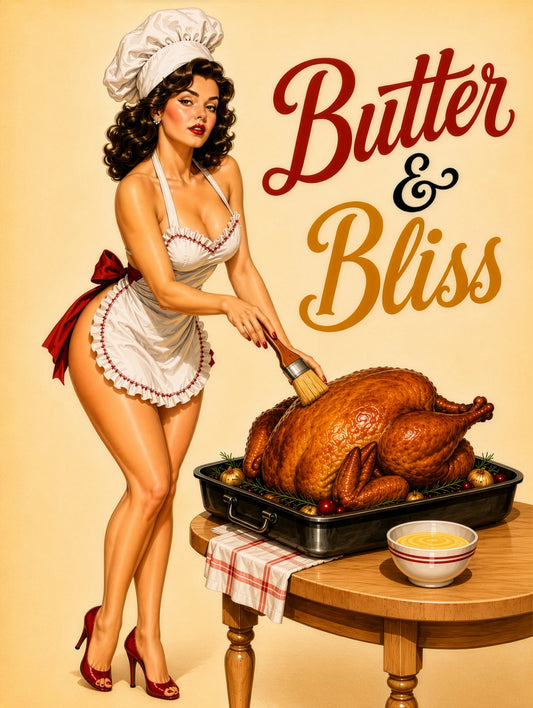
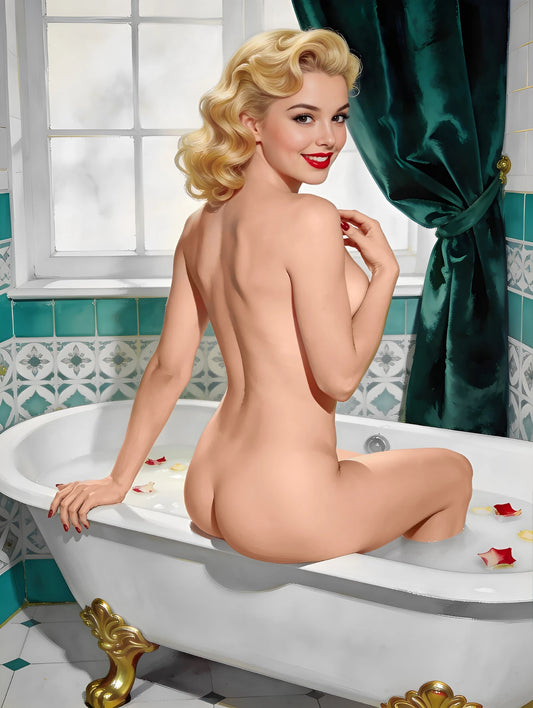
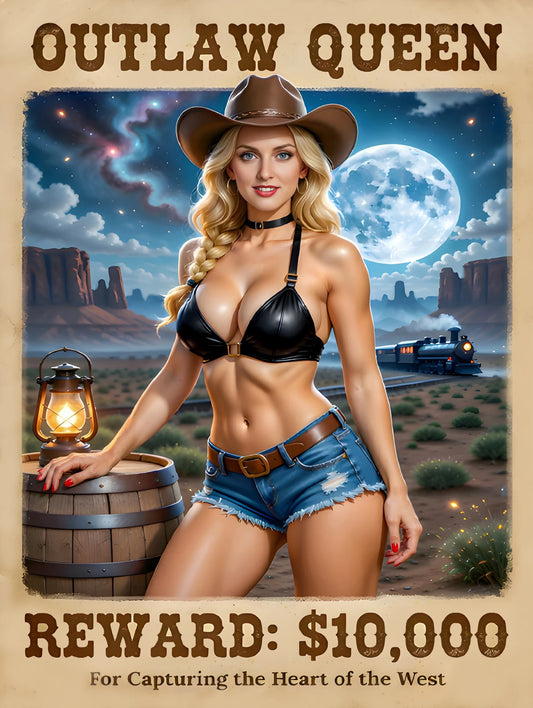
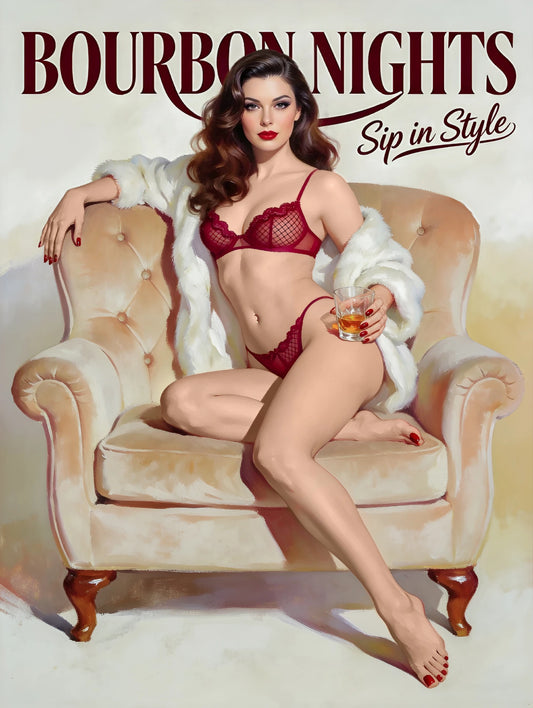
Ask most people to name a golden-age pin-up artist and you'll hear the same handful of names: Gil Elvgren, Alberto Vargas, maybe George Petty if they're a real collector. Almost nobody says Joyce Ballantyne. And yet there's a strong chance you've seen her single most famous painting more times in your life than every other pin-up artist's work combined — you just didn't know her name was attached to it.
Joyce Ballantyne was one of the only women working at the top level of pin-up illustration during its 1940s–50s golden age, holding her own in studios full of men, mentored by Gil Elvgren himself, and eventually creating one of the most reproduced advertising images in American history. She never set out to be a trailblazer. She set out to be good at her job, in an industry that wasn't built to let women do that job at all.
At Pinup Art Studio, Ballantyne's specific brand of warm, wholesome, "girl next door" glamour is one of the easiest looks to translate into a modern custom portrait — and we think her story deserves to be told alongside the male artists she worked beside and, in more than a few cases, outshone. Here's her life, her look, and how to commission a piece inspired by it. 🌟
🖌️ The Life of Joyce Ballantyne: From Omaha to Madison Avenue
Depression-Era Beginnings 🌾
Joyce Ballantyne was born on April 4, 1918, in Norfolk, Nebraska, and grew up in Omaha. Money was tight in the way it was tight for most families during the Depression, and by her own account she was selling hand-made paper dolls for a dollar apiece as a young girl — an early, almost on-the-nose sign of where her talent and her commercial instincts were headed at the same time.
She studied for two years at the University of Nebraska before transferring to the School of the Art Institute of Chicago and the American Academy of Art to train formally in commercial illustration. Commercial art, not fine art, was the deliberate choice — she wanted a career that paid, in a field where very few women were paid to draw anything at all.
Breaking Into a Man's Industry 🏙️
Her first professional work was about as far from glamour as illustration gets: maps for Rand McNally and book illustrations for Cameo Press, done while she was on staff at Kling Studios in Chicago. It was steady, unglamorous, and exactly the kind of grinding commercial work that built real technical skill.
The turning point came when she moved to the Stevens-Gross Studio, where she spent more than a decade working alongside some of the biggest names of the era — Al Moore, Al Buell, and most importantly, Gil Elvgren, whose own legendary career we've covered in detail in our guide to Gil Elvgren's pin-up legacy. Working in the same building as Haddon Sundblom — the artist who essentially invented the modern visual image of Santa Claus for Coca-Cola — Ballantyne absorbed the exact blend of polish and warmth that defined the best commercial illustration of the period.
The Brown & Bigelow Calendar Years 📅
In 1945, on Elvgren's own recommendation, Ballantyne began painting pin-up calendars for Brown & Bigelow, the biggest name in the calendar business. She designed direct-mail pin-up brochures and was eventually trusted with a full twelve-page "Artist's Sketch Pad" calendar — a serious vote of confidence in an industry that rarely extended that kind of trust to a woman artist.
She frequently used herself as the model for her own paintings, a detail that matters more than it might first appear. Almost every other major pin-up artist of the era was a man painting an idealized woman from the outside. Ballantyne, at least some of the time, was painting from the inside.
In 1954 she painted a full set of twelve pin-ups for a calendar published by Shaw-Barton. When it was released in 1955, demand was so overwhelming that the company had to reprint it multiple times — by any commercial measure, one of the most successful calendar runs of her career.
The Coppertone Moment 🐶☀️
Then, in 1959, working through Grant Advertising, Ballantyne painted the image that would eclipse everything else she'd ever done: a small, pigtailed girl on a beach, her swimsuit bottom being playfully tugged down by a curious black cocker spaniel, exposing a sliver of sunburn-free skin underneath. It became the Coppertone girl — one of the most recognized, most reproduced advertising images of the twentieth century, still instantly familiar to people who've never heard the word "pin-up" in their lives.
The model for that iconic little girl was Ballantyne's own three-year-old daughter, Cheri Brand.
Here's the twist that tends to surprise people: Ballantyne herself never considered the Coppertone girl her best or most meaningful work. She'd spent over a decade building a reputation as a serious pin-up and calendar artist among her peers, and the single image that made her a household name — even if nobody knew the household name attached to it — was, by her own description, just a quick commissioned job. It's a strange kind of immortality: the picture everyone knows, sitting right next to a body of work almost nobody does.
Beyond the Pin-Up: A Career in Fine Portraiture 🖼️
Ballantyne's range went well past pin-up calendars. Over her career she produced advertising illustrations for Sylvania television, Dow Chemical, Coca-Cola, Pepsi, Schlitz Beer, Ovaltine, Pampers, and General Motors — a client list that reads like a cross-section of mid-century American consumer life.
In her later career she shifted toward formal portraiture, painting commissioned portraits of public figures including the comedian Jonathan Winters and a number of business, military, and academic leaders of her era. It was, in a sense, a full-circle move: from painting idealized pin-up figures to painting real, specific, named individuals — which is precisely the kind of personal, likeness-based portrait work that Pinup Art Studio carries forward today, just with vintage pin-up styling applied to your own photo instead of a studio model's.
Final Years in Florida 🌴
In 1974, Ballantyne moved to Ocala, Florida, to be closer to family, settling into a large three-story building that doubled as home and studio. Her husband passed away in 1985, and in 2004 her daughter — the original Coppertone girl herself, by then a grown woman — moved in to help care for her. Ballantyne kept painting well into her final years and passed away on May 15, 2006, at the age of 88.
👗 The Ballantyne Look: Defining "The Girl Next Door"
A Different Kind of Sexy 💁♀️
If you put a Ballantyne pin-up next to one of the more theatrical Vargas girls — covered in our Alberto Vargas biography — the difference is immediate. Vargas leaned into elaborate, performative glamour: dramatic lingerie, exaggerated poses, a kind of staged theatricality. Ballantyne's women, by contrast, are usually dressed in ordinary clothes, caught in small, plausible, slightly awkward moments — fixing a stocking, laughing at something off-camera, caught mid-motion rather than mid-pose.
She summed up her own philosophy about as plainly as it's possible to sum up an entire artistic approach: she wanted the girl to look a little like your sister. Not a fantasy figure performing seduction, but someone believable who'd simply been caught in a moment that happened to be a little bit charming. It's a gentler, more democratic version of pin-up sexuality — playful and "accidentally" appealing rather than overtly staged — and it's exactly the quality that made her work feel different from her male contemporaries' even when it was hanging in the same calendar.
Painting From the Inside 🪞
That self-as-model habit comes back into focus here. A male illustrator painting an idealized woman is, almost by definition, painting from the outside looking in. Ballantyne, painting herself fixing her hair or straightening her seams, was occasionally doing something genuinely rare in golden-age pin-up art: showing you what it actually feels like to be the woman in the picture, not just what it looks like to watch her.
🌟 Why Joyce Ballantyne Matters Today
Pin-up art's golden age is overwhelmingly remembered as a story about men painting women. Ballantyne is the clearest counter-example — proof that a woman could not only compete at the absolute top level of a male-dominated commercial art world but produce one of its single most enduring images in the process. The Coppertone girl has outlived nearly every calendar pin-up from the era in terms of pure cultural recognition, and it came from the same hand, the same training, and the same studio culture that produced Elvgren's most famous calendar girls.
For anyone interested in the fuller, more honest history of pin-up art — not just the most famous male names, but the people who actually built the industry — Ballantyne is essential. She's also a reminder that the genre's "girl next door" wholesomeness, the version of pin-up that feels playful rather than purely staged for a male gaze, has a woman's fingerprints all over its DNA.
There's also a quieter lesson in how her two careers sit next to each other. The Coppertone girl is, by some measures, one of the most-viewed pieces of commercial art ever produced — printed on billboards, magazine pages, sunscreen bottles, and merchandise for well over half a century. Her pin-up calendars, meanwhile, are the kind of thing serious collectors now hunt down at auction precisely because so few people know to look for her name on them. Most artists get one legacy. Ballantyne ended up with two entirely different ones, running side by side, neither one cancelling the other out.
🖼️ Commissioning Your Ballantyne-Inspired Portrait
A handful of styles in our collection map especially well onto Ballantyne's specific aesthetic:
Classic Beauty Pin-Up Portrait — the warm, approachable glamour at the center of everything Ballantyne painted, well suited to a portrait that feels like you, not a costume.
Sweetheart Pin-Up Portrait — built around exactly the soft, "girl next door" charm Ballantyne made her signature.
Beach Pin-Up Portrait — the obvious nod to the Coppertone connection, for anyone who wants their portrait to carry a little sun-and-sand nostalgia.
Glam Pin-Up Portrait — for the more polished, classic calendar-girl side of her catalog.
For your reference photo, skip the elaborate costuming. Ballantyne's whole style worked because her women looked like they were wearing their own clothes, caught in a small, real moment — a candid laugh, a glance over the shoulder, hands mid-motion rather than a stiff, formal pose. A warm, genuine smile will do more for this style than any prop.
Once your portrait is finished, our vintage pin-up canvas and vintage pin-up framed canvas options both give it the kind of gallery presence that would do justice to a piece destined for Madison Avenue. You can browse the full range of available looks in our 1950s pin-up collection, and read more about the artists behind your portrait on our about us page.
🎁 A Ballantyne-Style Portrait Makes a Perfect Gift For
Because her aesthetic is warm rather than overtly staged, a Ballantyne-inspired portrait tends to work for people who might feel a little self-conscious about a more theatrical pin-up style:
- 🎨 Illustration and art history fans who appreciate the lesser-known names behind the golden age, not just the famous ones
- 🏖️ Beach house and coastal home decor — the Coppertone-adjacent aesthetic fits effortlessly into a beach cottage or lake house
- 👩👧 Mothers and daughters — a sweet nod to the real mother-daughter story behind the Coppertone girl herself
- 💁♀️ Anyone who wants playful glamour without the theatrics — warm and charming rather than overtly staged
- 🖼️ Women in art and design as a thoughtful gift celebrating an underrated figure in commercial illustration history
❓ Frequently Asked Questions
Q: Is Joyce Ballantyne the same artist who painted the Coppertone girl? Yes. The 1959 Coppertone billboard image — the girl on the beach with her swimsuit being tugged down by a small dog — was painted by Joyce Ballantyne, modeled on her own three-year-old daughter, Cheri Brand.
Q: What makes Joyce Ballantyne's style different from other golden-age pin-up artists? Where artists like Vargas and Petty leaned toward theatrical, staged glamour, Ballantyne's women are dressed in everyday clothes and caught in small, believable moments — a style she described as wanting the girl to look a little like your sister rather than a performer.
Q: Can I commission a portrait inspired specifically by Joyce Ballantyne's style? Absolutely. Our classic beauty, sweetheart, and beach pin-up portrait styles all capture the warm, understated glamour she was known for. Mention "Ballantyne-inspired" in your style notes at checkout and our artists will lean into that natural, candid feel.
Q: Did Joyce Ballantyne only paint pin-ups? No — she had an extensive commercial career illustrating ads for brands including Coca-Cola, Pepsi, Dow Chemical, and General Motors, and later moved into formal portraiture, painting public figures like comedian Jonathan Winters.
Q: How rare was it for a woman to work as a pin-up artist in the 1940s and 50s? Extremely rare. Ballantyne was one of only a small handful of women working at the top level of the industry during its golden age, in studios that were otherwise made up almost entirely of men.
Q: Why is the Coppertone girl considered separate from "pin-up art" even though the same artist painted both? Pin-up art was aimed at an adult audience and built around glamour and flirtation, while the Coppertone girl was a children's advertising image built around innocence and sunshine. The interesting part is that the same artistic hand — the same eye for warmth, charm, and a believable, unposed moment — produced both, even though they sit in completely different categories.
Q: Where can I see examples of Joyce Ballantyne's actual paintings? Many of her original works, including pieces like "Straightening the Seams" and "Fixing Her Hair," circulate through fine art auction houses and pin-up art archives. You won't find reproductions of her copyrighted originals at Pinup Art Studio — what we offer instead is an entirely original portrait of you, created in the spirit of her style.
🚀 Paint Your Own Page in Pin-Up History
Joyce Ballantyne spent a career proving that warmth and believability could be just as compelling as theatrical glamour — and that the "girl next door" was never a lesser version of the pin-up ideal, just a different, more honest one.
You don't need a billboard or a national ad campaign to carry that same energy. You just need a portrait that looks like you, caught in a moment that feels real rather than staged.
👉 Commission your own Ballantyne-inspired pin-up portrait at Pinup Art Studio today and become the next name in a tradition that's always had more women in it than the history books let on. 🎨🏖️