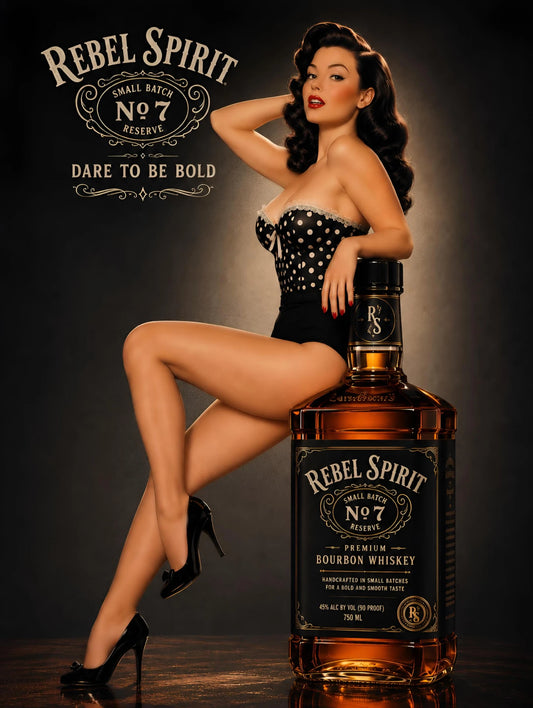
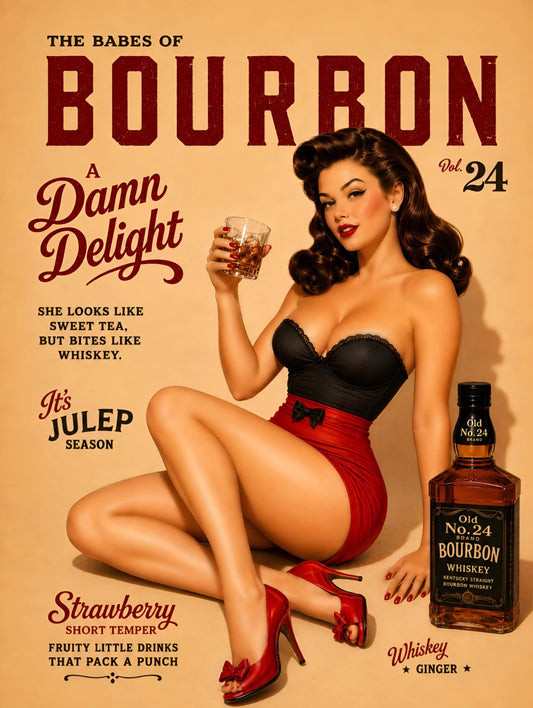
In the history of American commercial illustration — a history that includes some of the most skilled and visually influential artists of the 20th century — Alberto Vargas stands apart. Not simply as the most celebrated pin up artist, though he was. Not simply as the most technically accomplished, though that case is easily made. But as something more specific and more important: as a genuine original, an artist whose specific vision and specific mastery created something that no one before or since has quite replicated.
The Varga Girl — the luminous, impossibly elegant, warmly beautiful feminine figure that Vargas created over four decades of work — is one of the most recognizable and most reproduced artistic creations of the 20th century. She appeared on the pages of Esquire and Playboy. She was carried in wallets across every theater of WWII. She was tattooed on the arms of sailors and printed on the merchandise of millions.
Understanding the man who created her — his life, his training, his specific technical approach, his personal qualities — deepens appreciation of work that rewards the deepest attention.
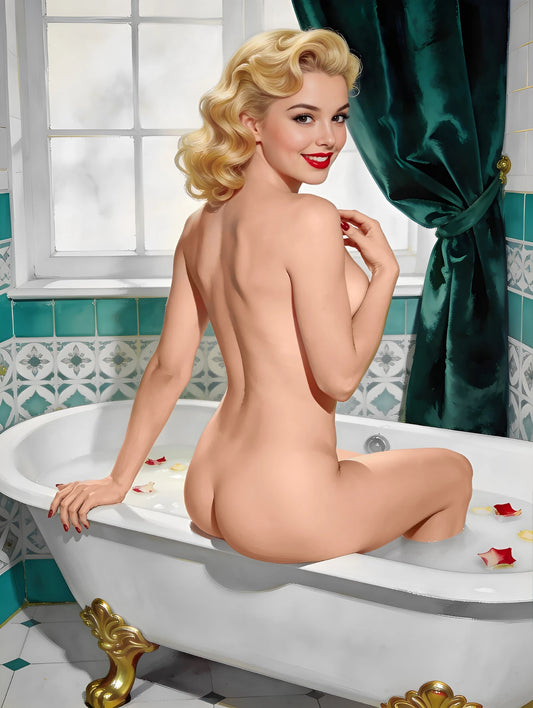
At Pinup Art Studio, our Vargas-style pin up portrait is a direct tribute to this extraordinary tradition. 🌹
📜 The Complete Biography of Alberto Vargas
Origins: Peru and Europe (1896–1916)
Alberto Vargas Chavez was born on February 9, 1896, in Arequipa, Peru — a colonial city in the Andes whose Spanish heritage and vibrant artistic tradition shaped his early sensibility.
His father, Max T. Vargas, was a celebrated Peruvian photographer — one of the finest in South America. Growing up in a household where the capture of the human form was taken seriously as an art and a craft, Alberto absorbed his father's understanding of light, composition, and the technical demands of visual reproduction.
The family's prosperity allowed Alberto to travel to Europe for his artistic education. He studied in Geneva and, crucially, in Paris — where he absorbed the Art Nouveau and early Art Deco traditions that would influence his mature work, and where he developed the technical foundations that would eventually support his extraordinary airbrushed style.
Arrival in America: New York and the Theater World (1916–1940)
Vargas arrived in New York in 1916 — a 20-year-old Peruvian artist with European training, extraordinary talent, and no established reputation in the world's most competitive commercial art market.
His entry into that market came through the theater — specifically through painting theatrical posters and portraits for Broadway and the Ziegfeld Follies. This work was formative in ways that shaped his mature style:
The theatrical portrait tradition demanded idealization — making subjects look their absolute best while maintaining recognizable likeness. Vargas developed this skill to an extraordinary level.
The Ziegfeld Follies connection gave him access to some of the most beautiful and most professionally glamorous women in America — subjects whose physical qualities and professional comfort in front of an appreciating audience made for extraordinary portrait material.
The understanding of staged beauty — how lighting, pose, costume, and context create the specific quality of glamour — was essential preparation for the pin up work that would define his career.
He also met and married Anna Mae Clift during these years — a love story that lasted until her death in 1974 and that, by all accounts, was the emotional foundation of his life and work.
The Esquire Years: Creating the Varga Girl (1940–1946)
The invitation from Esquire in 1940 was not just a career opportunity — it was the moment that matched an extraordinary talent with an extraordinary platform at precisely the right historical moment.
Vargas's Esquire work began appearing monthly with his signature simplified to "Varga" (the magazine dropped the 's' for copyright reasons they never fully explained). The response was immediate and enormous — reader mail flooded in, special reprint requests multiplied, and within months the "Varga Girl" had become the most requested single feature in Esquire's history.
What made the Varga Girls immediately distinctive:
The luminosity was unlike anything previously achieved in illustration. Vargas's airbrush technique, refined over years of theatrical portrait work, produced skin quality that appeared to emit its own warm light rather than simply reflect external light. The effect was hypnotic — figures that seemed to glow from within, existing in a slightly otherworldly space between the real and the ideal.
The proportions were deliberately idealized — elongated legs, graceful neck, small elegant feet — but in ways that felt aspirational rather than distorted. Unlike caricature, which exaggerates to grotesque effect, Vargas exaggerated toward perfection — creating figures that were recognizably human but specifically more beautiful than nature typically produced.
The minimal backgrounds were a deliberate choice that gave the figures a timeless quality. Without setting, without context, the Varga Girls existed in pure color space — more icon than illustration, more symbol than depiction.
The wartime distribution gave these figures an emotional weight that peacetime publication could not have created. Servicemen wrote thousands of letters to Esquire requesting Varga Girl images. The specific warmth — the specific promise of beauty and warmth existing somewhere beyond the war — made these technically extraordinary images into something almost devotional.
The bitter ending: Vargas's relationship with Esquire ended in legal dispute in 1946. The settlement was profoundly unfavorable — Vargas lost rights to the "Varga" name and was awarded inadequate compensation for years of extraordinary work. It was a personal and financial catastrophe that took years to recover from.
The Difficult Years (1947–1959)
The decade following his Esquire departure was Vargas's most personally difficult. Without a major platform, without the "Varga" name (legally forbidden to him by the Esquire settlement), and under financial strain, he produced commercial work — advertising illustrations, private commissions — that kept him working but denied him the creative platform his talent deserved.
These years are documented primarily through personal accounts and private correspondence. Anna Mae's unwavering support during this period is consistently cited as essential to his eventual recovery.
The Playboy Renaissance (1960–1985)
Hugh Hefner's appreciation for Vargas's work was genuine and enthusiastic. When Hefner invited him to contribute to Playboy beginning in 1960, he gave Vargas not just a platform but genuine creative respect — something the Esquire relationship had ultimately denied him.
The Playboy Vargas Girls are, by most critical assessments, his finest work:
Greater technical sophistication — Decades of additional practice had refined his airbrush mastery to levels the Esquire work only approached. The Playboy figures have a subtlety of skin rendering — the specific way warm and cool tones interact across the figure — that his earlier work doesn't quite achieve.
More ambitious compositions — Some of the Playboy pieces are the most compositionally complex of his career — figures in elaborate settings, with sophisticated spatial relationships.
Better reproduction — Playboy's superior printing quality allowed the full range of Vargas's airbrushed gradients to be reproduced for the first time with complete fidelity.
Creative freedom — Hefner gave Vargas genuine creative latitude, producing a body of work that reflects Vargas's own artistic vision rather than magazine editorial demands.
He continued contributing to Playboy until shortly before his death, maintaining extraordinary technical quality into his eighties.
Death and Legacy (1982–present)
Alberto Vargas died on December 30, 1982, in Los Angeles, aged 86. He left behind a legacy that has only grown in scope and appreciation since his death.
Original Vargas works — particularly the finest Playboy pieces — now sell for $100,000 to $500,000 at major auction houses. Academic recognition has grown. Museum exhibitions have featured his work. The specific technical mastery he developed has been extensively studied and remains the standard against which all airbrush figurative work is measured.
🎨 The Technical Legacy of Vargas
Understanding what Vargas actually did — mechanically, technically — helps explain why his work looks the way it does and why it has proven so impossible to fully replicate.
The layering system: Vargas worked in layers — transparent watercolor underpaintings beneath airbrush work, creating depth and complexity that single-medium work cannot achieve.
The masking technique: To achieve clean edges between areas of different color, Vargas used complex masking — covering areas to protect them while working adjacent areas. The precision of his masks allowed the clean separations between zones of his compositions.
The color temperature management: Vargas was exceptionally skilled at managing the temperature variation across skin — warm highlights, cool mid-tones, warm shadows — that creates the three-dimensional, life-like quality of the finest figurative painting.
🖌️ Commissioning in the Vargas Tradition
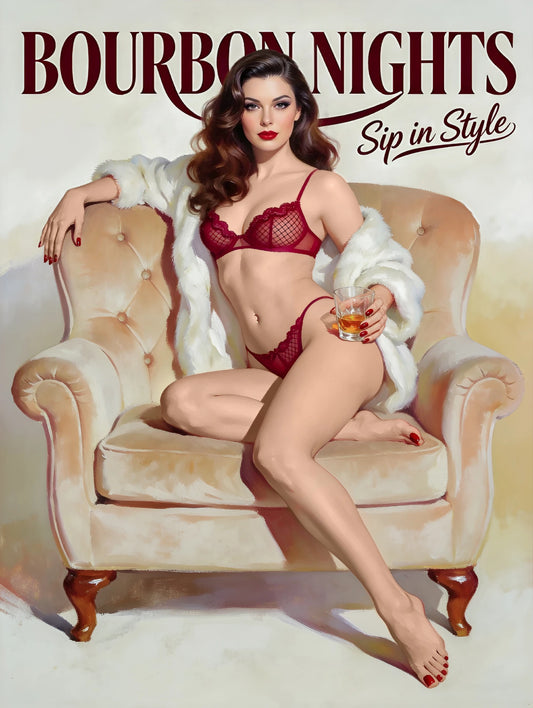
Our Vargas-style pin up portrait at Pinup Art Studio draws directly from everything described above — the luminosity, the elegant proportions, the minimal backgrounds, the specific warmth beneath the technical refinement.
Browse our full portrait range including the glam pin up portrait and Hollywood pin up portrait for related formal elegance approaches.
❓ Frequently Asked Questions
Q: Why is the Esquire pin up credited to "Varga" rather than "Vargas"? Esquire dropped the 's' for copyright purposes when they hired him in 1940. After his departure, the legal settlement actually prevented him from using the "Varga" name commercially for a period — one of the more bitter ironies of a difficult professional relationship.
Q: Where can I see original Vargas works? Major auction houses (Christie's, Sotheby's, Heritage Auctions) periodically sell original works. Some museum collections include Vargas pieces. For new work in his tradition, our Vargas-style portrait is the most accessible route.
🚀 The Legacy Continues
Alberto Vargas spent his career asking what beauty looked like when captured with complete technical mastery and genuine warmth. The answer he arrived at — the luminous, graceful, infinitely warm Varga Girl — changed American visual culture permanently.
👉 Commission your Vargas-inspired portrait at Pinup Art Studio today and become part of the most technically extraordinary tradition in pin up art history.
✨ The master's legacy. Your portrait. Luminous forever. 🌹