In the world of pinup art, there are artists — and then there is Alberto Vargas. The distinction is not one of fame (though Vargas was certainly famous) or commercial success (though that was considerable). It is a distinction of pure technical mastery — the specific quality of his work that makes it not just beautiful but genuinely extraordinary, not just commercial illustration but legitimate fine art.
Vargas pinups — first the Esquire "Varga Girls" of the 1940s, then the Playboy figures of the 1960s–80s — represent the highest technical achievement in the entire pin up tradition. The luminous skin quality achieved through his mastery of the airbrush. The impossibly elegant proportions that somehow managed to feel idealized rather than distorted. The specific quality of warmth that his figures projected despite their technical refinement.
At Pinup Art Studio, Vargas is one of our primary inspirations — and our Vargas-style pin up portrait is a direct tribute to his luminous tradition. In this comprehensive collection guide, we'll walk through every era of Vargas's work, the specific qualities that make each period distinctive, and how to commission your own portrait in this magnificent tradition.
📜 The Complete Vargas Career: Era by Era
The Early Career: Hollywood and Theater (1916–1939)
Alberto Vargas was born in Arequipa, Peru, in 1896. His father was a celebrated photographer, and from childhood he was immersed in the art of capturing the human form. He studied art in Geneva and Paris before arriving in New York in 1916.
His early American career was spent painting theatrical posters and portraits — work that honed his understanding of dramatic composition, the specific qualities of stage lighting, and the art of idealization. He painted Ziegfeld Follies showgirls, creating relationships and developing technical approaches that would define his later career.
Visual quality of early Vargas work: More directly influenced by his European academic training — stronger Art Deco elements, more formally compositional. Less luminous than the later Esquire work, more graphically dramatic.
The Esquire Years: The Varga Girls (1940–1946)
In 1940, Esquire magazine hired Vargas (dropping the 's' from his name for copyright reasons) to replace the departing George Petty as their pin up illustrator. The resulting "Varga Girls" became one of the most beloved features in American publishing history.
Visual quality of the Esquire Varga Girls:
- Fully realized airbrushed luminosity — skin that appears lit from within
- Elongated proportions — particularly the legs, which achieve an impossibly graceful length
- Minimal backgrounds — the figure exists in soft color gradients, isolated from any specific setting
- Warm, soft color palette — creams, peaches, warm pinks
- Direct engagement with the viewer — the figures look AT you, creating intimacy
The wartime dimension: The Esquire years coincided exactly with WWII — making the Varga Girls the most celebrated and most widely distributed fine-quality pin up images of the war. Special military distribution editions made these figures a constant presence in military life.
The Esquire split: Vargas's relationship with Esquire ended bitterly in 1946 — a rights dispute that left him without income or creative outlet for years. The legal settlement was profoundly unfavorable to Vargas.
The Lost Years (1947–1959)
The decade following his Esquire split was Vargas's most difficult. Without a major publishing partner and exhausted by legal disputes, he produced work sporadically — advertising illustrations, commercial work, private commissions.
Visual quality: More variable than the peak Esquire work — some pieces maintain the luminous quality of his finest work, others show the strain of financial pressure and creative uncertainty.
Collector significance: Works from this period are relatively rare and when they appear in good quality are particularly valued by collectors.
The Playboy Years: The Mature Masterworks (1960–1985)
Hugh Hefner's invitation to contribute to Playboy beginning in 1960 rescued Vargas's career and gave him the resources and creative freedom to produce some of his finest work.
Visual quality of the Playboy Vargas Girls:
- Even more refined than the Esquire work — decades of additional technical mastery visible in every element
- More sophisticated color — richer, more complex, more deliberately orchestrated
- More elaborate compositions — some Playboy pieces are the most ambitious of his entire career
- Better print reproduction — Playboy's superior printing allowed the full subtlety of his airbrushed gradients to be visible for the first time
The Playboy Vargas Girls are, by most critical assessment, his finest works — the full realization of the technical ambitions that the Esquire period had established.
The Late Career (1985–1982)
Vargas continued working into his eighties with undiminished passion and largely undiminished technical mastery. The late career works have a quality of hard-won serenity — the specific beauty of an artist who has spent a lifetime refining a craft and arrived at something close to perfection.
🎨 The Technical Secrets of Vargas Pinups
The Airbrush Mastery 💨
Vargas was among the first major illustrators to master the airbrush as a fine art tool — using compressed air to spray paint in ultra-fine gradients that created his characteristic skin quality.
What the airbrush allowed Vargas to achieve:
- Impossibly smooth skin transitions with no visible brushstrokes
- A sense of light emanating from within the figure
- Delicate, feathery hair and fabric details through masking and layering
- Dimensional depth through careful management of highlight and shadow
The Watercolor Foundation 🎨
Vargas typically began with a watercolor underpainting before applying airbrush work. This gave his images a particular warmth and color complexity — the watercolor's natural variation showing through the airbrushed layers.
The Proportional System 📐
Vargas developed a consistent approach to figure proportions:
- Elongated legs — the single most distinctive Vargas proportion
- Long, graceful neck
- Small, delicate feet always in high heels
- Hands and fingers given extraordinary attention
The Background Minimalism 🌅
Unlike Elvgren, who created detailed narrative settings, Vargas typically used minimal backgrounds — soft color gradients or subtle abstract compositions. This choice focused all attention on the figure and gave his work a timeless quality — his figures exist outside any particular moment.
🖌️ The Vargas-Style Portrait at Pinup Art Studio
Our Vargas-style pin up portrait at Pinup Art Studio is a direct tribute to these technical and aesthetic achievements:
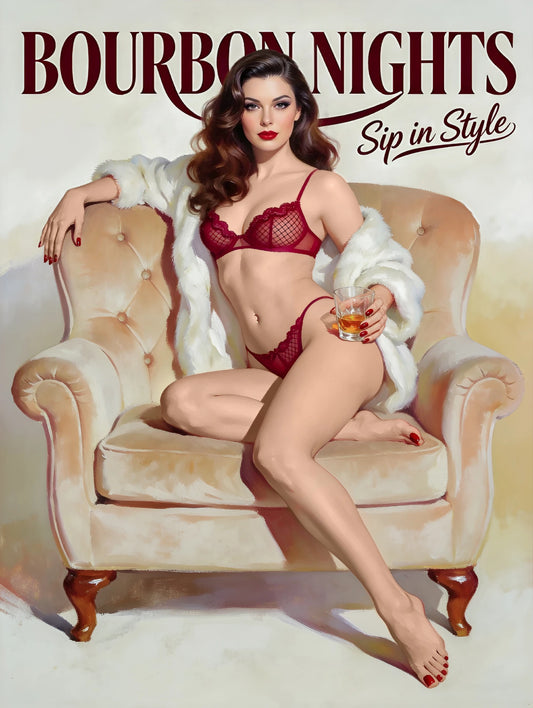
Luminous skin quality — Our artists work specifically to achieve the warmth and dimensionality that characterizes Vargas's finest skin rendering.
Minimal backgrounds — Soft color gradients that focus all attention on the subject, in the Vargas tradition.
Elegant proportions — Figures rendered with the graceful elongation that distinguishes Vargas's work from more naturalistic pin up styles.
Warmth despite refinement — The specific quality that made Vargas's figures beloved rather than merely admired — warmth visible even through the technical perfection.
🎁 Vargas-Style Portraits as Gifts
Perfect for:
- 🎨 Art collectors who will immediately recognize and deeply appreciate the tradition
- 💌 Valentine's Day — the luminous beauty of a Vargas-style portrait is deeply romantic
- 🎂 Milestone birthdays — the most artistically sophisticated birthday tribute
- 💛 Self-gift — commission your own Vargas-style portrait as the ultimate self-celebration
Display with our vintage pin up framed canvas for gallery-quality presentation. 🌟
❓ Frequently Asked Questions
Q: What's the difference between the Esquire Varga Girls and the Playboy Vargas Girls? The Esquire work (1940–1946) is slightly warmer and more accessible. The Playboy work (1960–1985) is more technically refined and compositionally ambitious. Both are extraordinary — the choice depends on whether you prefer the wartime-era accessibility or the mature technical masterwork quality.
Q: Are original Vargas works available to buy? Yes — through major auction houses and specialist dealers. Original Vargas works command significant prices ($50,000–$500,000+). For new work in his tradition, our Vargas-style portrait at Pinup Art Studio offers the most accessible route.
Q: What portrait style at Pinup Art Studio is closest to the Vargas tradition? Our dedicated Vargas-style pin up portrait is specifically designed around his aesthetic principles. The glam pin up portrait and Hollywood pin up portrait offer related maximalist and formal elegance approaches.
🚀 Own Your Place in the Vargas Tradition
Alberto Vargas spent his life asking: what would it look like if beauty were truly captured, truly honored, truly elevated into something permanent and luminous?
The answer he created — the Varga Girl — changed American visual culture. Now that same question can be asked about you.
👉 Order your Vargas-style pin up portrait at Pinup Art Studio today and find out.
✨ The luminosity. The elegance. The warmth beneath the perfection. Your portrait. 🌹